

Vol. 20 Issue 1, Spring 2015
by Joe Coleman and Donna Quinn
“It’s exciting seeing Loudoun Wildlife Conservancy continue to develop and grow. We often wonder how organizations become part of our community and here we are creating it. We’re developing an organization that will endure and benefit future generations.” Nicole Hamilton, first Executive Director, November 2014.
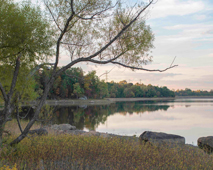
Photo by Chris Chaves
Loudoun County’s complex geologic history fashioned a rich and varied landscape that welcomed diversity and an abundance of wildlife. Its 521 square miles, including 6 square miles of water, and elevations ranging from 180 to 1,999 feet, encompass mountains, valleys, streams, forests, vernal pools, wetlands and meadows, which offer an array of opportunities for flora and fauna to thrive. Centrally located and within easy access to centers of commerce, information, travel, politics and power, it is no wonder more and more humans have also found Loudoun County an attractive place to reside and raise their young.
By 1994, our county population neared 100,000 and the soon to be completed Dulles Greenway promised high-speed access to still more people desiring to live in this beautiful and conveniently located county. Wildlife habitat was being destroyed at an alarming rate, and increasing numbers of our wild neighbors found themselves without a home. At this time, a small group of concerned residents gathered around a farmhouse kitchen table to talk about what could be done to protect wildlife habitat in Loudoun. These four individuals understood that while development was inevitable in such a desirable location, it could be done responsibly and with attention to also preserving wildlife habitat.
The Loudoun Wildlife Conservancy was founded in 1994 with the mission to “Promote the preservation and proliferation of healthy wildlife habitats throughout Loudoun County by fostering an understanding of the value of nature and providing opportunities for applying that knowledge to the betterment of the natural environment.” Twenty years later, this small group has grown to more than 1,000 members, as well as partners and hard-working executive, administrative, board and committee members – plus the many individuals who participate in supporting wildlife and our mission from outside the organization. Today, more attention than ever is being given to the necessity of preserving nature, as much for the emotional and physical health of humans, as for wildlife itself. While much wildlife habitat has been destroyed, it is also true that we have the power to solve problems, plan ahead, create and protect. We can and do make a difference!
Promoting the preservation and proliferation of healthy wildlife habitats
The organization’s founders defined our mission to promote preservation of healthy habitats because the greatest threat to wildlife is the loss of habitat; they also felt it was not enough just to preserve habitat but we must also increase it. In our first program, Jocelyn Sladen, a founding member of the Virginia Native Plant Society, described to an audience of about 25 people the importance of native plants to wildlife. Fast forward to 2011, when Dr. Douglas Tallamy, the author of Bringing Nature Home, encouraged 250 attendees to replace non-native yard habitats with native plants to give birds, butterflies, bees and other wild neighbors a chance not just to survive, but to thrive.
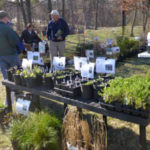 We were inspired! Today, 76 properties totaling 1,580 acres have been certified as Audubon at Home sanctuaries in Loudoun, providing pollinators and other wildlife with pesticide-free, healthy habitats in our own backyards. Our Audubon at Home program and native plant sales assist the community by providing plants and educational materials on how to create wildlife refuges in our home gardens. We’ve also been planting milkweed and other native nectar plants, creating a mosaic of Monarch waystations, each patch contributing to increasing wildlife habitat throughout the county. At the end of last summer, there were 171 certified Monarch waystations in Loudoun, plus many more not yet certified.
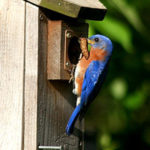 Bluebirds are testimony to how increasing habitat can dramatically change the status of a species. After populations declined 90 percent, today we once again enjoy these symbols of happiness and gratefully accept their natural pest control service. Our bluebird nest box monitoring program includes 452 bluebird nesting boxes – with more boxes added each year. Last year, 1,130 Eastern Bluebirds, 917 Tree Swallows and 220 young of other species fledged from our nesting boxes! Because of the efforts to provide bluebird nesting habitat nationally as well as locally, we are thrilled to say Eastern Bluebirds are a conservation success story.
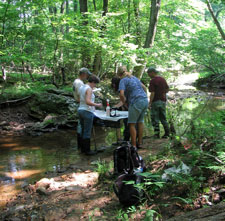
Many of our initial efforts as a conservancy involved advocating for clean water. In 1999 we were recognized by the Town of Leesburg for our riparian buffer restoration efforts. In 2000 we joined the Loudoun Clean Streams Coalition and held workshops describing steps the county’s citizens could take to make sure its waterways are protected and kept clean. Over the past decade we have partnered with other organizations and have worked alongside hundreds of volunteers on restoration projects, such as the South Fork of the Catoctin, where we planted more than a thousand trees and shrubs. Today, this site and other riparian buffer restoration areas serve not only to protect waterways, but also to shelter wildlife and offer soothing landscapes for humans.
While Loudoun Wildlife Conservancy plays an important role in just about every nature preserve in the county, one of our greatest successes was the creation of the Banshee Reeks Nature Preserve. In spite of numerous threats, including its possible sale to developers and construction of a golf course or ball fields, the 725-acre Banshee Reeks Preserve was saved largely through the efforts of Loudoun Wildlife. In the press and over the phone, we succeeded in rallying the county’s citizens to ask the Board of Supervisors to keep Banshee Reeks natural. On April 21, 1999, the Board of Supervisors voted to make Banshee Reeks the county’s first nature preserve. It is important to keep in mind our nature preserves exist because people went to great efforts to protect them.
Over the years, Loudoun Wildlife Conservancy has been a voice for conservation by rallying our members to speak before the Board of Supervisors and other government decision-making bodies on a variety of issues affecting habitat and biodiversity. We have partnered with other organizations such as Dulles Greenway, the Blue Ridge Center for Environmental Stewardship, Friends of Banshee Reeks, and the Willowsford Conservancy, as well as local schools, churches and private industry who share our mission. For 20 years our leadership and vision have helped protect thousands of acres of wildlife habitat which have provided countless opportunities for people to enjoy the natural world.
Fostering an understanding of the value of nature
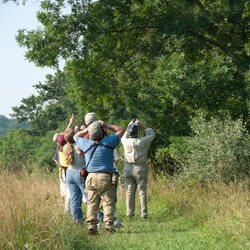 From the beginning, education through outreach, programs and field trips have been critical to accomplishing Loudoun Wildlife Conservancy’s mission. Each year we provide a remarkable offering of walks, events and programs covering a wide range of topics and activities. Walks and field trips promise adventures for novices as well as experienced birders and nature lovers. The common theme throughout our events is the importance of wildlife, how dependent it is on healthy, native habitat, and what we can do to create and maintain wildlife habitat. All this plus how much fun and deeply satisfying it is for humans to connect with nature.
We’ve always recognized the importance of fostering a love of nature in our children. Even before 1999, when Less Sinn began our Young Naturalists Program, we focused on introducing the wonders of the natural world to children in a variety of activities, opportunities and programs. We’ve helped create outdoor nature classrooms and Monarch waystations at schools. Our Youth Environmental Education committee has offered nature book clubs and after-school nature clubs. We’ve generously supported scout projects and organized outdoor nature summer camps for children. At our annual meeting we recognize exceptional students with science fair project awards and the Roger Tory Peterson Nature Journal Awards. Perhaps the most rewarding experience of all, however, is when a child who participated in our programs returns to us as an adult dedicated to conservation work. Young people remind us how important it is to nurture a love and appreciation for nature; they represent our future.
Providing opportunities for applying that knowledge to the betterment of the natural environment
Loudoun Wildlife Conservancy has been committed to not just doing something because it feels right, but because that action is based on sound science. Stream monitoring was our first major scientific monitoring project in partnership with three other organizations. The data gathered in stream monitoring translated into programs educating the public on the importance of maintaining clean water through healthy riparian buffers, the protection of flood plains and the implementation of best management practices for controlling soil erosion in development projects.
 In 1997, Loudoun Wildlife held its first Annual Butterfly Count under the auspices of the North American Butterfly Association and Xerces, as well as its first Christmas Bird Count under the umbrella of the National Audubon Society. We have now documented 18 years of butterfly and bird counts in Loudoun. Over these 18 years we’ve seen many changes including Bald Eagles making their incredible post-DDT comeback, the almost complete disappearance of Northern Bobwhites and the rapid decline of once common Monarchs.
We are currently compiling the findings of our five-year Bird Atlas project. This ground-breaking program tallied over 64,500 bird sightings by 85 volunteers. This important work tracks population trends of birds in our county and helps us identify areas where we can help protect birds, especially those with declining populations.
Whenever we feel it is necessary to take action, our first step is to collect data; everything we do is based on scientific fact. When county administration decided to spray for ticks, the conservation advocacy working group, led by chairperson Alysoun Mahoney, carefully researched and prepared a position paper (Rebalancing Loudoun County’s Approach to Mitigating Lyme Disease, February 2014). This paper played an important role in the county’s decision to survey tick populations and re-examine the safety of spraying pesticides. Ultimately, the county decided to discontinue spraying for ticks in parks for the time being. Our approach and this document demonstrate the power of advocating for conservation based on sound science, and the impact thorough research and fact gathering can have on policy.
Loudoun Wildlife Conservancy also provides fresh approaches to managing human-wildlife conflicts. We encourage the community to reach out to us when such conflicts occur. We provide educational materials to help understand the problem and offer long-term solutions, not quick and often destructive, temporary fixes.
Looking to the future
Some ask why care about nature and wildlife? If natural beauty and the astonishing diversity of life is not enough, and even if one would want to live in a place where children could not play in meadows and woods, where there were no clean waterways to refresh us in summer, or no Spring Peepers announcing the end of winter, there are many other reasons to protect healthy natural habitats. An internet search for “benefits of nature” reveals strong evidence that direct contact with nature improves mental health, reduces stress, boosts self-confidence, and fosters a sense of well-being. Families who enjoy nature together know these interactions strengthen bonds and create lasting memories. If for no other reason, there is economic value to protecting wild places. Properties with more natural diversity are worth more. Pollination, sanitation, water purification, pest control, carbon dioxide sequestration – all critical life providing services – are given freely by nature. All nature asks of us is a chance to exist.
We’ve reached a critical point in conservation locally and globally. Our actions today determine the future of many species, not just here in Loudoun County, but also in distant places we are connected to by epic migrations, air and water, seeds, wings, feet and fins. We thank all of you who have supported our mission through hands-on volunteering, financial donations and partnerships – we wouldn’t be where we are today without you. As we look to the future, we hope you will join us in protecting wildlife habitats and connecting people with nature – the future is in our hands.