

Entries tagged with “Bles”.


Seven of us went out to Bles Park in Ashburn, Virginia on Saturday night for a fun night hike to look and listen for frogs.  This is just the second of such night hikes that we’ve done so far but they’re so much fun that we’ll definitely be doing more starting next spring when the frogs and toads are really out in force.

Pickerel_Frog_Bles_Park_8_8_09For our walk last Saturday, we started by gathering in the parking area, discussing the possible species that we would encounter and listening to recordings of their calls. Through past nature walks at Bles, we’ve identified at least six species of frogs and toads that are definitely at Bles, but due to the time of year, we were most likely to only hear three of them (Green Frog, Gray Tree Frog and Bullfrog).

So, off we went along the trail. Bill Roberson from the county’s Parks and Recreation dept came out as a resource for us in case of anything which was great since it allowed us to just focus on wildlife. The park certainly looks different at night but donned with headlamps and flashlights, we were able to spot all sorts of great creatures.

As we walked along, we encountered numerous (at least 20)  juvenile American Toads (toadlets) out hunting for dinner -  hopping across our path and hunting through the grasses. There were also quite a few millipedes out hunting along with some really interesting beetles.

We were hoping for a slight drizzle to get the frogs to call but it missed us and the frogs stayed pretty quiet except for a lone Green Frog that called from along the river. As we explored along the river, we saw a bat or two hunting over the water. By the size of it, I’m guessing a Big Brown Bat.  We’ll have to bring the bat detector next time. We also had Great Blue Herons flying over just as the sun was setting.

The big fun of the evening was spotting the many Pickerel Frogs along the river.  They would have been breeding in the early spring time so it’s no surprise that they were not calling out their funny snore but it was great to spot them and practice some night photography.

We wrapped up our hike at 9pm.

  • Share/Bookmark

In this issue, we have a spotlight on Bles Park, a great place for nature walks and other nature adventures in the hh-spring-09-1Ashburn area.  I love going there in the summer to photograph birds and butterflies as well as to listen to the chorus of cricket frogs. Its a splendid refuge for some peace and quiet with nice fresh air and the gentle trickle of the river passing by.  In this article, Bonnie Eaton talks about other hidden treasures at this great place.

Also in this issue, we have the continued adventures of Zoom and Compass as they discover worms. There’s also an interesting article on the Mourning Cloak butterfly, and a story of the lifecycle of bumblebees and their humble bumble homes (which you can build as a neat project). You can also learn about Lichens….part fungi, part algae or cyanobacteria…..oh this crazy world!

And, as always, our programs from now through July are listed along with programs offered by organizations with which we partner.

This latest edition of the Habitat Herald will be going out to our members in the next week. If you’re not yet a member, we could really use your support! You can join online. Your membership will run through December 2009!  ($20 for an individual, $30 for a family) and, it is tax deductible as allowed by the law. 

If you join soon we can get this latest issue of the Habitat Herald out to you in our next mailing – if you join after we have our mailing party then you’ll receive a copy of this issue in your New Member Information packet. The Habitat Herald is a member benefit and is published each quarter.

  • Share/Bookmark

Andy Rabin led a family bird walk at Bles Park in eastern Loudoun Co on Saturday morning. Most of the warblers we saw were close and gave us great views. 

The following is the report that we also posted on eBird:
Location:     Bles Park
Observation date:     10/4/08
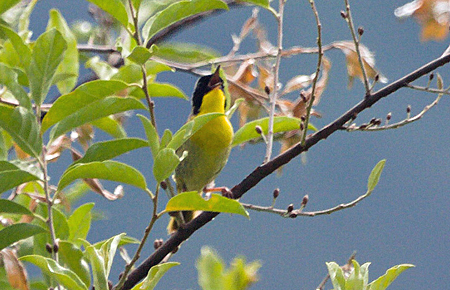
Notes:     Andy Rabin led a Family Bird walk at Bles Park in eastern Loudoun Co this morning.  The highlights were some well-seen warblers including a NASHVILLE, NORTHERN PARULA, and a PALM WARBLER.  Besides good numbers of CHIMNEY SWIFTS and TREE SWALLOWS we also found a few INDIGO BUNTINGS.
Number of species:     40

Canada Goose, Turkey Vulture, Red-shouldered Hawk, Red-tailed Hawk, American Kestrel, Rock Pigeon, Mourning Dove, Chimney Swift, Belted Kingfisher, Red-bellied Woodpecker, Downy Woodpecker, Hairy Woodpecker, Northern Flicker, Eastern Phoebe, Blue Jay, American Crow, Fish Crow, Tree Swallow, Northern Rough-winged Swallow, Carolina Chickadee, Tufted Titmouse, White-breasted Nuthatch, Carolina Wren, Ruby-crowned Kinglet, Eastern Bluebird, Gray Catbird, Northern Mockingbird, European Starling, Nashville Warbler, Northern Parula, Yellow-rumped Warbler, Palm Warbler, Common Yellowthroat, Song Sparrow, Northern Cardinal, Indigo Bunting, Red-winged Blackbird, House Finch, American Goldfinch, House Sparrow

We also saw a few butterflies including Cabbage White, Clouded Sulphur, Common Buckeye, Eastern Comma, Monarchs

Joe Coleman

note: Photo shown is a flycatcher

  • Share/Bookmark

We had a great day of hunting dragons and damsels across the fine Loudoun countryside! Seven people joined us as Andy Rabin and Kevin Munroe, both real experts in dragonflies and damselflies, took us out into the field.

We started the day at 10am at Bles Park then went to Claude Moore at noon and ended the day at Kephart Bridge Landing.

In total, we had 29 species!

Dragonflies: Common Green Darner, Swamp Darner, Unicorn Clubtail, Black-shouldered Spinyleg, Prince Basketail, Umber Shadowdragon, Calico Pennant, Halloween Pennant, Common Pondhawk,Spangled Skimmer, Slaty Skimmer, Widow Skimmer, Common Whitetail, Twelve-spotted Skimmer, Blue Dasher, Spot-winger Glider, Eastern Amberwing, Autumn Meadowhawk, Black Saddlebags

Damselflies: American Rubyspot, Blue-fronted Dancer, Powdered Dancer, Blue-tipped Dancer, Dusky Dancer, Familiar Bluet, Stream Bluet, Citrine Forktail, Eastern Forktail, Southern Spreadwing

Throughout the day, we practiced our netting skills, used small containers to look at individuals that we caught, and practiced how to properly hold a dragonfly for identification and release them.  The colors and patterns of all the varied species were beautiful.

Many thanks to Andy and Kevin for sharing this with us.

  • Share/Bookmark