Entries tagged with “BRCES”.


I’m very tardy in posting this but still wanted to send it out for those tracking our local and migrating birds.

From Joe Coleman:

Nine birders saw 54 species, including 8 species of warblers and one very large and distant flock of blackbirds, at the Blue Ridge Center for Environmental Stewardship (BRCES) in northwestern Loudoun Co, near Harper’s Ferry, WV, this morning.  We started at the large field at the end of Sawmill Rd where we not only watched a large and distant flock of blackbirds dance in mass over the ridge, a flock of Tree Swallows passed overhead.  We walked both the Sweet Run Loop trail and the power line cut to the top of the ridge to the Appalachian Trail (and looked into West VA). Along the way we came across three or four groups of migrants.  One group, where the power line crosses Sweet Run, included both our first RUBY-CROWNED KINGLET for the season (the first of at least six) and a WHITE-THROATED SPARROW. The other groups included a variety of warblers, esp. one along Sweet Run where we found at least 7 different species of warblers, including a FOS YELLOW-RUMPED WARBLER, as well as the Gray-cheeked Thrush and Swainson’s Thrush.  The Bald Eagle, a juvenile, was seemed from the parking lot as well as the first of several flocks of Cedar Waxwings.  A pair of Common Ravens flew over us on the power line cut near the ridge.  While there were a number of Magnolia Warblers and Common Yellowthroats in the scrub under the power lines most of the warblers were in a heavily wooded stretch along Sweet Run where there were a lot of grapes.  The Cedar Waxwing flocks popped up in a number of locations.

Information on the Blue Ridge Center for Environmental Stewardship can be found at http://www.blueridgecenter.org.   Information on the Loudoun Wildlife Conservancy and its many free public activities can be found at www.loudounwildlife.org.

Joe Coleman, near Bluemont, Loudoun Co

Location:     Blue Ridge Center for Environmental Stewardship – MFF01
Observation date:     9/26/09
Notes:     We started at the large field at the end of Sawmill Rd and walked both the Sweet Run Loop trail and the power line cut to the top of the ridge to the Appalachian Trail. Along the way we came across three or four groups of migrants.  One included both our first Ruby-crowned Kinglet for the season and White-throated Sparrow. The others included a variety of warblers, esp. one along Sweet Run loop where we found at least 7 different species of warblers as well as the Swainson’s & Gray-cheeked Thrushes.  The Bald Eagle, a juvenile, was seemed from the parking lot as well as the first of several flocks of Cedar Waxwings.
Number of species:     54

Canada Goose, Black Vulture, Turkey Vulture, Osprey 2, Bald Eagle 1, Sharp-shinned Hawk 1, Red-shouldered Hawk 2, Red-tailed Hawk 1, American Kestrel 2, Mourning Dove, Chimney Swift 1, Ruby-throated Hummingbird 2, Belted Kingfisher 1, Red-bellied Woodpecker, Downy Woodpecker, Hairy Woodpecker 1, Northern Flicker, Pileated Woodpecker, Eastern Wood-Pewee 1, Eastern Phoebe 1, Red-eyed Vireo 1, Blue Jay, American Crow, Common Raven 2, Tree Swallow 30, Carolina Chickadee, Tufted Titmouse, Carolina Wren, House Wren 2, Ruby-crowned Kinglet 6, Eastern Bluebird, Gray-cheeked Thrush 1, Swainson’s Thrush 1, American Robin, Gray Catbird, Northern Mockingbird, Brown Thrasher 1, European Starling, Cedar Waxwing, Chestnut-sided Warbler 1, Magnolia Warbler 8, Black-throated Blue Warbler 3, Yellow-rumped Warbler 1, Bay-breasted Warbler 1, Black-and-white Warbler 4, American Redstart 1, Common Yellowthroat 8, Eastern Towhee1, Song Sparrow, White-throated Sparrow 1, Northern Cardinal, Rose-breasted Grosbeak 1, Indigo Bunting 10, blackbird sp. 250, American Goldfinch

  • Share/Bookmark

Blue-Gray-GnatcatcherJoe Coleman led our bird walk at the Blue Ridge Center on Saturday and sent over this report with the highlights:

Eleven birders found 45 species on the regular monthly (every 4th Sat.) bird walk at the Blue Ridge Center in northwestern Loudoun County yesterday morning.  While it was pretty damp and foggy when we started due to the high humidity & the 2″ of rain that had fallen in the previous 36 hours, the rain held off though the sun never came out. 

The species we found included a Cerulean Warbler which was associating with one of several flocks of very active Cedar Waxwings that were busy eating fruit and fly catching, a few Eastern Meadowlarks around the farm, and several young Common Yellowthroats.  We started off in the scrubby fields around the Visitor Center, took the Farmstead Loop to the Piney Run Spur, crossed Piney Run on the Little Turtle Trail bridge, and then forded Piney Run where the Old Bridge Trail crosses it for a total of about 2.5 miles.
 
It was a pleasant walk where our biggest problem was that many of the birds stayed high in the canopy and those of us with eye glasses kept having them fog up.  Because of the heavy cloud cover there weren’t nearly as many butterflies as the week before.  However, we did find a fascinating caterpillar with long white hairs right after we crossed the Old Bridge Trail ford.  It turns out it was an early instar of a Black-waved Flannel.  The Princeton Field Guide to “Caterpillars of Eastern North America” writes “although they appear soft and harmless, flannel moth larvae are among our most well-defended insects.  Beneath the soft outer hairs are warts fortified with hollow, poison-filled stinging spines” – glad we were careful while looking at this fascinating insect.
 
Information on the Blue Ridge Center for Environmental Stewardship can be found at http://www.blueridgecenter.org.   Information on the Loudoun Wildlife Conservancy and its many free public nature program can be found at www.loudounwildlife.org.

Here’s the full list of birds seen:

Green Heron, Black Vulture, Turkey Vulture, Cooper’s Hawk, Red-shouldered Hawk, Mourning Dove, Yellow-billed Cuckoo, Chimney Swift, Ruby-throated Hummingbird, Red-bellied Woodpecker, Downy Woodpecker, Northern Flicker, Pileated Woodpecker, Eastern Wood-Pewee, Acadian Flycatcher, Eastern Phoebe, Red-eyed Vireo, Blue Jay, American Crow, Barn Swallow, Carolina Chickadee, Tufted Titmouse, White-breasted Nuthatch, Carolina Wren, House Wren, Blue-gray Gnatcatcher, Eastern Bluebird, American Robin, Gray Catbird, Northern Mockingbird, Brown Thrasher, European Starling, Cedar Waxwing, Cerulean Warbler, Common Yellowthroat, Eastern Towhee, Chipping Sparrow, Field Sparrow, Song Sparrow, Northern Cardinalm Indigo Bunting, Eastern Meadowlark, House Finch, American Goldfinch, House Sparrow

  • Share/Bookmark

“You’re going to count butterflies?” That’s the response many of us get when we tell the un-initiated how we’re going to spend our Saturday as the day of the great butterfly count approaches, and this year was no exception except that we had more people that ever jump in to help with this endeavor! In past years, our participants have numbered around 35 but this year, over seventy people of all ages came out to count! We were also fortunate to have eight leaders available this year so we could split up into more teams and truly cover our count circle.

butterfly_countersOur butterfly count was held on August 1stand we had a great day for it. Butterflies need the warmth of the sun to fly so having the temperatures in the 70s and 80s was perfect. Our eight teams had pre-determined meeting spots and participants met up at 9am. My team started at Ida Lee Park with the master gardener’s butterfly garden and then headed north along Route 15. Cliff Fairweather’s team started at Rust Sanctuary and then went along the W&OD trail as well as other points through Hamilton. Covering the center and north of our count circle was Mona Miller and her team as they started at Phillips Farm and then headed up to Lovettsville. Tom Raque and Eric Raun covered the Purcellville and Lincoln areas, doing justice to some great gardens, farms and parks through there. Jon Little led his team along Appalachian Trail Road and the Blackburn Center, while Bob Blakney and Larry Meade led two teams at the Blue Ridge Center for Environmental Stewardship.

In all, our teams counted 4,899 individual butterflies and saw 46 different species. While we’ve had slightly higher diversity on a few of our counts, forty-six is pretty much on par. In terms of overall number of butterflies, this was the second highest in our thirteen years (in 2005 we had 5,042 individual butterflies). The higher number of individual butterflies this year may be due to having more participants spotting and identifying but we’ll have to watch this for future trends.

least_skipper_8_1_09The interesting thing about this year’s count had to do with the species that were low in number versus those that were high. Least Skippers, for instance, made a real showing. In past years we’ve averaged 20-30 individuals but this year we had 386! We had similar observations with Clouded Sulphurs (774 this year compared to 80-100 in past years), Orange Sulphurs (393 this year compared to approximately 60 in past years) and Silvery Checkerspots (227 compared to approximately 20 in past years). Monarch butterflies (193 spotted) as well as Eastern-tailed Blues (242) and Spring/Summer Azures (22), were consistent with past counts.  

Overall, the swallowtail and fritillary butterflies were low in numbers and outside of the Least Skipper, we didn’t see as many skippers in general this year. Red-Spotted Purples, while better than last year, were still low in number. Hairstreaks were also either very low or not present. In terms of rare sightings, Mona Miller’s team was lucky to find a Giant Swallowtail at Butterfly Hill Farm in Lovettsville. They are always an impressive butterfly to see.  

A big “Thank You” to our count leaders and all of our participants! We couldn’t have counted all these butterflies without you and hope you’ll join us again next August!

To learn more about our butterfly count, visit the Loudoun Butterfly Count on our website. You can also download the Butterfly Count Summary of Data to look at the trends over the years.

  • Share/Bookmark

Joe Coleman led our butterfly walk yesterday at the Blue Ridge Center and sent over this great write-up from the walk:

On Aug. 15, nine of us spent 3 hours searching for butterflies at the beautiful and diverse Blue Ridge Center for Environmental Stewardship (BRCES) in northwestern Loudoun County. BRCES (www.blueridgecenter.org) is one of my favorite spots in the county because it includes a wide variety of habitats, including extensive wetlands, rich upland oak-hickory forests that climb up the side of the Blue Ridge Mountains to the Appalachian Trail, and extensive natural meadows along the powerline. It is located in the Between the Hills Valley, only a couple of miles from Harpers Ferry and the confluence of the Shenandoah and Potomac Rivers.

BRCES-farm_loop_trailBRCES also includes large open fields where haying is rotated and Mountain View Farm, which is managed by Shawna DeWitt and Atilla Agoston. Atilla took some time away from farming to explain to us that all of their produce and flowers are grown without chemical fertilizers or pesticides; and that their livestock grazes in the pastures, drink spring water, are not fed antibiotics, and never receive hormones.

He explained why they plant a lot of flowers in rows next to and among their crops. The flowers attract pests away from their crops and some of the herbs attract a number of the small bees and wasps that parasitize the caterpillars that that would devour a tomato plant in 24 hours.

All of this results, as shown in our Annual Butterfly Count, in BRCES being is one of the richest spots in the county for finding butterflies. We spent almost two hours yesterday morning on the farm and around the Visitor Center. Phil Daley assisted with the walk and Ray Smith, one of the participants, shared his extensive knowledge of the natural world with us.

BRCES-Eastern-Tiger-Swallowtail-AugustAfter wrapping up at the farm we headed over to the Arnold Road trail, much of which is surrounded by heavy forest with a lush understory. While there were not nearly as many butterflies there, we did add several species that specialize in wooded habitats.

Between the two localities we found 22 species of butterflies, not a great day at BRCES, but certainly respectful. And if we had found the time to include the aptly named Butterfly Alley, the trail along the power cut, we would have surely added several more species.

We did find: Black Swallowtail Eastern Tiger Swallowtail, Spicebush Swallowtail, Cabbage White, Clouded Sulphur, Orange Sulphur, Gray Hairstreak, Eastern-tailed Blue, Variegated Fritillary, Great Spangled Fritillary, Meadow Fritillary, Silvery Checkerspot, Pearl Crescent, Hackberry Emperor, Northern Pearly Eye, Monarch, Silver-spotted skipper, Least Skipper, Tawny-edged Skipper, Little Glassywing, Zabulon.

More information on Mountain View Farm at the Blue Ridge Center can be found here: www.blueridgecenter.org/farming/mvfarm.html

  • Share/Bookmark

So we held our first evening amphibian foray into the woods last night.  The plan was to enjoy the Gray Tree Frog chorus at the Blue Ridge Center, since in past years, the chorus was in full swing this time of year. The Gray Tree Frogs, however, must have missed the note because they stayed quiet all evening.

That was ok though, since lots and lots of American Toads and Green Frogs, as well as one Bullfrog, were out andGreen_Frog_July_25_2009 about.

We started the evening with a short talk about amphibians and Gray Tree Frogs in particular, looked at photos of the frogs (including the egg and tadpole stages as well as frog scat!) and listened to a recording of the Gray Tree Frogs calling so we all knew what to listen for. 

We had 18 people on the walk with us, three of whom were burgeoning (6-8 year old) herpetologists. As we headed out along the trail, it didn’t take long to find our first American Toad crossing the path.  The three young boys hopped into action and caught it so we all could see.

We stayed at the pond near the visitors center for a bit as we listened to the Green Frogs calling and swimming through the green duckweed. We then headed down to Piney Run stream to see if we could hear some other species….like our elusive Gray Tree Frogs. Along the walk, we must have encountered at least 15 more American Toads – of all shapes and sizes. We had just had a light rain and it was humid so they were no doubt out hunting for their dinners.

Along Piney Run, we listened for a bit, observed some bats feeding just over the tree tops, and scanned the trees for any eyes watching us. After a pause here, we headed back to the pond. By this time, it was dark and the Green Frogs, with their banjo twang, were in full song. We used our headlamps and flashlights to scan the pond and saw lots of eyes reflecting back. It was great to see so many of them.

We wrapped up a little past 9pm and headed back to the visitor center where we found another toad hunting around the house. It was fun doing a nightime nature walk and we look forward to doing it again. Keep an eye on the Loudoun Wildlife Conservancy Programs Calendar for more events like this.

  • Share/Bookmark

Ten people, including a couple celebrating their 27th wedding anniversary, participated in the Loudoun Wildlife Conservancy’s free monthly bird walk, led by Joe Coleman & Larry Meade, at the Blue Ridge Center this morning and found 56 species in the fields and woods there. 

After listening to a couple of Grasshopper Sparrows and the first of many (maybe 30) Indigo Buntings we carpooled toBRCES_Bird_Walk_Al_Eddy the southern edge of the center at the end of Sawmill Rd.  From there we walked along the western edge of the field where we heard and saw a variety of birds including a couple of White-eyed Vireos but missed on the Blue-winged Warblers and Chats that nest in that area. 

We then followed Butterfly Alley to Sweet Run & into the dense forest along the stream to the Arnold Rd Trail.  Within 200 yds of entering the woods we started hearing numerous Acadian Flycatchers (about one every 100 yards or so) and a few Wood Thrushes, but not a single Kentucky Warbler or Ovenbird, both of which were common in this area just a few weeks ago.  However, we did start hearing and then finally got great looks at several Scarlet Tanagers, a few of which were beginning to molt.

We took a side trip to Gordon Pond where we heard and saw a number of the same forest species as before and added a few more including several Blue-gray Gnatcatchers.  After visiting the Gordon Pond we returned to the Little Turtle Trail where a few of us heard a Worm-eating Warbler. 

Louisiana_Waterthrush_Al_Eddy_BRCESAfter crossing Piney Run we took the Farmstead Loop back to the Visitor Center, arriving there about 12:15.  There was a flurry of activity around the small pond near the Visitor Center, including a very cooperative Louisiana Waterthrush which posed for photos.  We added a couple more species, including a Raven, while tallying on the porch. 
 
When we drove back to Sawmill Rd to pick up our cars about 12:30 there was a Blue-winged Warbler in the hedgerow next to the parking area.
 
In addition to a lot of different butterflies, we also saw two large Black Snakes, one high in the trees where there was a lot of bird activity and one high on the side of one of the old stone houses on the center. There were also American Toads all along the trail and numerous green frogs at the pond. It was a great day for exploring Loudoun nature!

Al Eddy caught some great nature and wildlife photos during the walk and a few are included here in this post. 

Number of species:     56

Green Heron, Black Vulture, Turkey Vulture, Red-shouldered Hawk, Mourning Dove, Yellow-billed Cuckoo, ChimneyAmerican_Toad_BRCES_Al_EddySwift, Ruby-throated Hummingbird, Belted Kingfisher, Red-bellied Woodpecker, Downy Woodpecker, Hairy Woodpecker, Pileated Woodpecker, Eastern Wood-Pewee, Acadian Flycatcher, Eastern Phoebe, Great Crested Flycatcher, Eastern Kingbird, White-eyed Vireo, Red-eyed Vireo, Blue Jay, American Crow, Fish Crow, Common Raven, Barn Swallow, Carolina Chickadee, Tufted Titmouse, White-breasted Nuthatch, Carolina Wren, Blue-gray Gnatcatcher, Eastern Bluebird, Wood Thrush, American Robin, Gray Catbird, Northern Mockingbird, Brown Thrasher, European Starling, Cedar Waxwing, Blue-winged Warbler, Worm-eating Warbler, Louisiana Waterthrush, Common Yellowthroat, Scarlet Tanager, Eastern Towhee, Chipping Sparrow, Field Sparrow, Grasshopper Sparrow, Song Sparrow, Northern Cardinal, Blue Grosbeak, Indigo Bunting, Common Grackle, Orchard Oriole, House Finch, American Goldfinch, House Sparrow

  • Share/Bookmark

On Saturday, June 27, we had our monthly bird walk at the Blue Ridge Center for Environmental Stewardship. Sponsored by the Loudoun Wildlife Conservancy and led by Joe Coleman, 5 warbler species were found, along with 36 other species.  Highlights were 2 singing Cerulean Warblers, Worm-eating Warbler, Ovenbird, Louisiana Waterthrush, and several Common Yellowthroats.  The Wormie came in to scold us, making us wonder if its nest was nearby.  We heard several Wood Thrushes and Scarlet Tanagers, catching glimpses of both, and heard just one Yellow-billed Cuckoo.  A Black Vulture emerged from one of the abandoned houses in the old settlement, where it likely has its nest.

Following is the complete list of birds seen:
Black Vulture, Turkey Vulture, Red-shouldered Hawk, Mourning Dove, Yellow-billed Cuckoo – 1, Ruby-throated Hummingbird watching us from a telephone wire, Red-bellied Woodpecker, Downy Woodpecker, No. Flicker, E. Wood-Pewee, Acadian Flycatcher – 4, E. Phoebe, Great Crested Flycatcher – 3, Red-eyed Vireo – 6, Blue Jay, Am. Crow, Tree Swallow, Car. Chickadee, Tufted Titmouse, White-breasted Nuthatch, Carolina Wren, House Wren, Blue-gray Gnatcatcher – 4, E. Bluebird, Wood Thrush – 6, Am. Robin, Eur. Starling, Cedar Waxwing – 5, Cerulean Warbler – 2, Worm-eating Warbler – 1, Ovenbird – 1, Louisiana Waterthrush – 1, Common Yellowthroat – 3, Scarlet Tanager – 3, Chipping Sparrow, Field Sparrow, Song Sparrow, No. Cardinal, Indigo Bunting, Com. Grackle, Am. Goldfinch

  • Share/Bookmark

birding_brces_5_23_09Twenty-six people participated in the Loudoun Wildlife Conservancy’s free monthly bird walk at the Blue Ridge Center for Environmental Stewardship (BRCES). The walk was led by Joe Coleman and Larry Meade who were great at pointing out birds and helping newer birders so we all got good looks.

As we walked through the meadows of the organic farm and through the forest along Arnold Road, we found 59 different species of birds and a nice variety of butterflies. It was a delightful day to be outside and the birding was great though the heavily-leafed out trees did make it difficult to find many of the extensively vocalizing birds. We had fun at one point trying to locate an Acadian Flycatcher (pictured below) that was calling no more than 20 feet in front of us, demonstrating its great camouflaging.

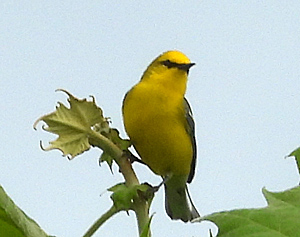
Our most interesting sighting occurred towards the end of the walk near noon when there were only about a dozen of us left. We came across a bird that sounded just like a GOLDEN-WINGED WARBLER but looked just like a BLUE-WINGED WARBLER.  It was in an area, near the Visitor Center, where we also heard and saw two or three BLUE-WINGED WARBLERS. 

Other highlights were several vocalizing (& 1 seen) YELLOW-BILLED CUCKOOS, a HAIRY WOODPECKER, an EASTERN WOOD-PEWEE on a nest, nine warbler species including BLUE-WINGED, CERULEAN, KENTUCKY, and YELLOW-BREASTED CHAT, as well as several SCARLET TANAGERS and GRASSHOPPER SPARROWS.  As a testament to how quickly the spring migration happens, the only species we encountered that was clearly a migrant was the BLACKPOLL WARBLER, of which we saw three: two males and one female.

acadian_flycatcher_brcesFollowing is the full list of the birds heard and seen during our walk: Canada Goose, Great Blue Heron, Black Vulture, Turkey Vulture, Red-shouldered Hawk, Mourning Dove, Yellow-billed Cuckoo, Ruby-throated Hummingbird, Red-bellied Woodpecker, Downy Woodpecker, Hairy Woodpecker, Northern Flicker, Pileated Woodpecker, Eastern Wood-Pewee, Acadian Flycatcher, Eastern Phoebe, White-eyed Vireo, Yellow-throated Vireo, Red-eyed Vireo, Blue Jay, American Crow, Fish Crow, Tree Swallow, Barn Swallow, Carolina Chickadee, Tufted Titmouse, White-breasted Nuthatch, Carolina Wren, House Wren, Blue-gray Gnatcatcher , Eastern Bluebird, Wood Thrush, American Robin, Gray Catbird, Northern Mockingbird, Brown Thrasher, European Starling, Cedar Waxwing, Blue-winged Warbler, Blackpoll Warbler, Cerulean Warbler, American Redstart, Ovenbird, Louisiana Waterthrush, Kentucky Warbler, Common Yellowthroat, Yellow-breasted Chat. Scarlet Tanager, Eastern Towhee, Chipping Sparrow, Field Sparrow, Grasshopper Sparrow, Song Sparrow, Northern Cardinal,  Indigo Bunting, Common Grackle, House Finch, American Goldfinch, House Sparrow

  • Share/Bookmark

This morning, 21 people came out for our monthly bird walk at the Blue Ridge Center for Environmental Stewardship.  Jon & BJ Little led the group which enjoyed seeing so many different types of birds – from waterfowl to raptors to warblers to thrushes. In all, 63 species and many exciting first of season (FOS) birds were seen!  These spring walks are so amazing in diversity - as we get the mix of birds passing through combined with year-round and summer residents. Laura Weidner sent over the full list:

Canada Goose 6, Wood Duck 1, Mallard 2, Wild Turkey 1, Great Blue Heron 6, Great Egret  6, Black Vulture 1, Turkey white_eyed_vireo_4_25_09Vulture 8, Osprey  2, Sharp-shinned Hawk 2, Red-shouldered Hawk 1, Broad-winged Hawk 2, Rock Pigeon  2, Mourning Dove  6, Barred Owl 1, Red bellied Woodpecker 12, Yellow bellied Sapsucker 1, Downy Woodpecker 6, Hairy Woodpecker 1, Pileated Woodpecker 6, Eastern Phoebe 1, Great Crested Flycather  4, White eyed Vireo  6, Yellow Throated Vireo  8, Blue headed Vireo 1, Warbling Vireo  2, Red eyed Vireo  1, Blue Jay  4, American Crow  6, Tree Swallow 6, Barn Swallow 2, Carolina Chickadee  10, Tufted Titmouse 10, White breasted Nuthatch 3, Carolina Wren 2, Blue gray Gnatcatcher  35, Eastern Bluebird 3, Hermit Thrush  1, Wood Thrush  8, American Robin 13, Northern Mockingbird  2, Blue winged Warbler  7, Yellow Warbler  2, Palm Warbler  1, Cerulean Warbler 1, Black and white Warbler  1, Ovenbird  8, Louisiana Waterthrush  3, Kentucky Warbler 2, Common Yellowthoat  3, Scarlet Tanager  5, Eastern Towhee  10, Chipping Sparrow  6, Field Sparrow 8, White throated Sparrow  3, Northern Cardinal 8, Eastern Meadowlark  3, Brown headed Cowbird  5, Orchard Oriole 2, Baltimore Oriole 2, Purple finch 4, Pine Siskin  1, American Goldfinch  12.

Great time was had by all!
Peace & Good Birding To All.
Laura Weidner
Loudoun County

  • Share/Bookmark

Mary Ann Good and Laura Weidner led our bird walk this morning.  Here’s their report brown-thrasher-apr-1-2007-2of cool birds and other sightings:

Seven people enjoyed birding the Blue Ridge Center for Environmental Stewardship, but due to the occasional misting rain, found ourselves looking down as much as up.  We managed to find 35 species of birds, including our first spring Louisiana Waterthrush singing loudly, Brown Creeper, and Fox Sparrow.  Just as fascinating on a non-birdy morning were the many egg masses of Spotted Salamander and Wood Frog, pointed out by biologist extraordinaire Liam McGranaghan, as well as an unusual variety of fungi helped along by the rains, including tiny Bird’s Nest, Witch’s Butter, and large numbers of a most interesting one most of us had never seen before: Lattice Puffball.  We also spotted a Raccoon curled up in a tree hole keeping warm and dry.

The list of birds follows:
Canada Goose, Turkey Vulture, Mallard, Mourning Dove, Belted Kingfisher, Red-bellied Woodpecker, Downy Woodpecker, Hairy Woodpecker – 2, No. Flicker, Pileated Woodpecker, E. Phoebe – 5, Blue Jay, Am. Crow, Fish Crow, Tree Swallow, C. Chickadee, Tufted Titmouse, White-breasted Nuthatch, Brown Creeper, Carolina Wren, E. Bluebird, Am. Robin, No. Mockingbird, E. Starling, Louisiana Waterthrush, Field Sparrow, Fox Sparrow – 2, Song Sparrow, White-throated Sparrow, Dark-eyed Junco, No. Cardinal, Red-winged Blackbird, Brown-headed Cowbird, Am. Goldfinch, House Sparrow

  • Share/Bookmark