

Vol. 16 Issue 2, Summer 2011
By Nicole Hamilton
The trees were cleared. The wetlands were filled and graded as if they never existed. The houses went up. Fescue, oh, sorry, lawns were rolled out. Two trees and seven bushes per lot — species that had genes of Asia pumping through their veins —were planted. Insects died out from lack of food. Wildlife, the ones that lived here year-round and were mobile, moved out, crowding the remaining wild places, competing for food and shelter. Box turtles, salamanders, and others faithful to their natal lands perished or were pushed to the edge at best. Then spring came. The great throbbing heartbeat of the earth’s cycles grew louder, sending millions of songbirds home to breed — to find a wasteland.
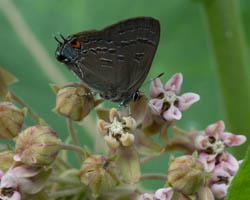
Banded Hairstreak on milkweed
Photo by Nicole Hamilton
This scene plays out daily around us. Just listen and look and you will see it. But who doesn’t love a success story? A chance to make a difference and leave a legacy of a place that was better than when we discovered it?
Extinction happens slowly and silently … tick, tock, another species drops off the clock … but every day, we are given a gift; we are given the chance to change course. In Doug Tallamy’s book, Bringing Nature Home, he explains how we have cleared the native landscape and replaced it with plants from Asia and elsewhere, leaving nothing more than islands of native habitat and isolated wildlife populations. These islands are the last vestiges where enough food can be found to try to squeak through another year along the slow ride of population decline.
You can see these islands in and around your neighborhood. They are the pockets of trees or wild fields that may have a “for sale” sign on them or were set aside as common areas or undevelopable lands and edges. These are the places where diversity hangs on — where native plants live and serve as food for insects that evolved specifically to feed on them.
These are the places the songbirds come because even though non-native plants creep in, they still support enough insect life to allow the birds to survive. The breeding season is fairly short for most songbirds — one brood, one chance. They need to feed their young the highest protein packed morsels they can as quickly as possible, so their young can grow and live on as the next generation. Insects serve this purpose.
But when habitat runs out, when we remove the native plants, we remove the insects. The store is empty. Non-native plants are not well recognized as food by our native insects. They didn’t evolve together. They are as foreign to our native insects as they are to you and me. Without native plants to eat, insect populations decline, and along with them other species begin to disappear. Ninety-six percent of our songbirds rely on insects for food, so you can see the problem.
However, there is a fix, if we have the will and desire to follow through. We humans are fairly smart and resourceful. When we focus on something, we achieve it. We got to the moon after all. By replanting the landscapes around our homes, we can restore communities of native plants, rebuild habitat, rebuild connections that make islands fade into the fabric of a healthy ecosystem, and we, along with our neighbors, can live more richly for it.
So how do we begin? Start by planting native trees, shrubs and wildflowers that have the greatest wildlife benefit. Did you know that an oak tree can support 534 different moth and butterfly species! As you know, butterflies start off as caterpillars, which birds love to eat and their babies gobble up! Butterflies that use oaks as host plants include: Banded Hairstreak, Red-spotted Purple, Juvenal’s Duskywing, and Horace’s Duskywing. And, Red-banded Hairstreak caterpillars like to eat the fallen, rotting leaves. Mourning Cloaks enjoy the sap as adults. The tree’s acorns are a very important food source for bobwhite quail, Wild Turkeys, ducks, woodpeckers, Blue Jays, Brown Thrashers, towhees, nuthatches, Gray Squirrels, flying squirrels, chipmunks, raccoons, groundhogs, rabbits, opossums and deer. This is the food web in action. Studies have shown that even the slightest increase in native plants increases the populations of birds, butterflies and other wildlife. They just need us to do our part.
There are so many incredible and beautiful native plants that you can use to restore your landscape. As you begin to redo your yard’s landscaping, talk with your neighbors — connect the dots, connect the islands. Given the right habitat, the diversity and numbers of birds will rebound as will other wildlife. Here in Loudoun, we have more than 295 species of birds. They are waiting for you, hoping for you, to take action and bring nature home.
Here is a table* of native plants that have the greatest ability to support biodiversity in our area:
| Trees & Shrubs |
Perennials |
|||||
| Common Name | Genus | # of butterfly & moth species supported | Common Name | Genus | # of butterfly & moth species supported | |
| Oak | Quercus |
534 |
Goldenrod | Solidago |
115 |
|
| Black cherry | Prunus |
456 |
Asters | Aster |
112 |
|
| Willow | Salix |
455 |
Sunflower | Helianthus |
73 |
|
| Birch | Betula |
413 |
Joe Pye, Boneset | Eupatorium |
42 |
|
| Poplar | Populus |
368 |
Morning glory | Ipomoea |
39 |
|
| Crabapple | Malus |
311 |
Sedges | Carex |
36 |
|
| Blueberry | Vaccinium |
288 |
Honeysuckle | Lonicera |
36 |
|
| Maple | Acer |
285 |
Lupine | Lupinus |
33 |
|
| Elm | Ulmus |
213 |
Violets | Viola |
29 |
|
| Pine | Pinus |
203 |
Geraniums | Geranium |
23 |
|
| Hickory | Carya |
200 |
Black-eyed Susan | Rudbeckia |
17 |
|
| Hawthorn | Crataegus |
159 |
Iris | Iris |
17 |
|
| Alder | Alnus |
156 |
Evening primrose | Oenothera |
16 |
|
| Basswood | Tilia |
150 |
Milkweed | Asclepias |
12 |
|
| Ash | Fraxinus |
150 |
Verbena | Verbena |
11 |
|
| Rose | Rosa |
139 |
Beardtongue | Penstemon |
8 |
|
| Filbert | Corylus |
131 |
Phlox | Phlox |
8 |
|
| Walnut | Juglans |
130 |
Bee balm | Monarda |
7 |
|
| Beech | Fagus |
126 |
Veronica | Veronica |
6 |
|
| Chestnut | Castanea |
125 |
Little bluestem | Schizachyrium |
6 |
|
*Source: Doug Tallamy, Professor of Entomology and Wildlife Ecology, University of Delaware
The non-native plants in your yard are just taking up space, so as you restore your habitat, remove non-native plants and put back in their holes some native ones. Additionally, reduce the size of your lawn. This gives you more space for beautiful perennials and other native wildflowers to thrive. Fescue grass which makes up most lawns is non-native and is widely recognized as a wildlife wasteland, so the less of it you have the better.
Where there’s a will, there’s a way. If you’ve read this far, then I’m guessing you have the will. To help you with the way, there are a number of resources you can use, plus you can always email us with questions at contact@loudounwildlife.org:
Doug Tallamy’s website.
Loudoun Wildlife Conservancy’s Gardening for Wildlife Plant List.
Sources for native plants: Ask your local nursery to order what you need, it will show there is a demand for natives, or visit these native nurseries: Hill House Farm and Native Nursery, Nature By Design.
I hope you will take on this challenge of transforming your landscape. Every journey starts with a single step and, in this case, a single plant. You own your landscaping, and you decide what grows there. You can make a difference. Every native plant you grow makes a difference.
Send us your before and after photos, tell us your story of transforming your landscape, and tell us about the adventures with wildlife you have because you’ve brought back the natives. We’re excited for you in this journey! The first 10 respondents will receive a free copy of the book Bringing Nature Home. Loudoun Wildlife Conservancy also will recognize your work in an upcoming issue of the Habitat Herald. As Doug Tallamy says, “Let’s garden as if life depended on it,” because it does!